STRENGTHENING Floor Mat • Intermediate
Discs: T6-T7, T7-T8, T8-T9, T9-T10, T10-T11, T11-T12, T12-L1, L1-L2, L2-L3, L3-L4, L4-L5, L5-S1
Bird-Dog McGill Stabilization
Designed by spine biomechanics pioneer Dr. Stuart McGill, the Bird-Dog challenges rotational stability and trains the posterior oblique sling (latissimus dorsi + contralateral gluteus maximus) while keeping the spine in a safe neutral position.
BIOMECHANICAL MOVEMENT DIAGRAM
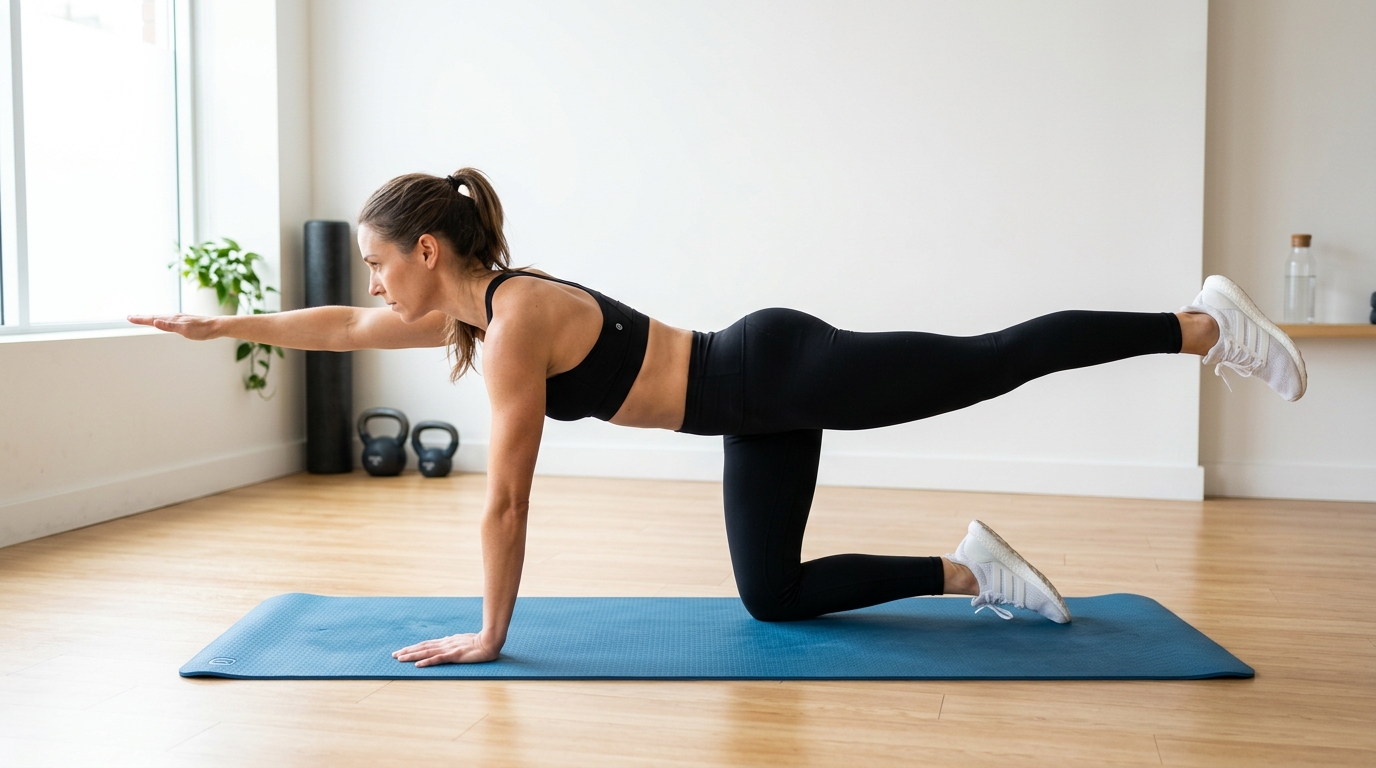
MCGILL CORE STABILIZER
🎯 Rotational Control
Step-by-Step Execution
CLINICAL PROTOCOL- 1 Start on all fours with hands directly under shoulders and knees under hips. Keep your spine in a neutral tabletop.
- 2 Brace your abdominal wall lightly without holding your breath.
- 3 Simultaneously reach your right arm straight forward and kick your left leg straight back until parallel to the floor.
- 4 Hold the outstretched position for 5 seconds while keeping your hips level like a tray of drinks.
- 5 Return to tabletop under control and repeat with the opposite arm and leg (left arm, right leg).
🎯
KEY FORM CUES
- ✓ Imagine balancing a cup of water on your lower back; do not let your hips twist or dip.
- ✓ Kick through the heel with toes pointing down to engage the glute rather than the lower back.
⚠️
MISTAKES TO AVOID
- ✗ Do not lift your arm or leg too high, which causes excessive lumbar hyperextension.
- ✗ Avoid rotating the pelvis open toward the ceiling.
🛑
CONTRAINDICATIONS & WHEN TO AVOID
Do not perform this movement or modify strictly under clinical supervision if you have:
- Severe acute rotator cuff tear or shoulder impingement
SCIENTIFIC FOUNDATIONS & CITATIONS
Clinical Biomechanics & Evidence
This exercise protocol utilizes proven spinal mechanics: active core co-contraction (McGill stabilization), directional preference extension (McKenzie MDT), and non-compressive axial elongation to facilitate nutrient exchange in the avascular intervertebral disc matrix.
• McGill, S.M. (2016). Low Back Disorders: Evidence-Based Prevention and Rehabilitation. Human Kinetics.
• Delitto, A., et al. (2021). Low Back Pain Clinical Practice Guidelines. Journal of Orthopaedic & Sports Physical Therapy (JOSPT).
CLINICAL DOSAGE
Hold Duration 5 Seconds
Repetitions 8 reps per side
Prescription Sets 2 sets
Difficulty Intermediate
Position Floor Mat
TARGET MUSCLES
Multifidus Erector Spinae Gluteus Maximus Transverse Abdominis
STABILIZER MUSCLES
Deltoids Trapezius Hamstrings